
The Best Frameworks for Website Development will empower developers and businesses alike, offering tools that make the process more efficient, scalable, and innovative. In 2026, Website Development continues to evolve with cutting-edge frameworks that redefine how we build and maintain websites.
Why Frameworks Matter in Website Development
Frameworks play a crucial role in website development for several reasons, particularly when it comes to efficiency, maintainability, and scalability. Here are some of the key reasons why frameworks matter:
1. Efficiency and Speed
- Prebuilt Components: Frameworks provide pre-built modules, libraries, and tools, saving developers from writing code from scratch.
- Standardized Development: They offer a structured way to build applications, reducing the time spent on decision-making about architecture and best practices.
- Rapid Prototyping: Frameworks allow for quicker prototyping and deployment of projects.
2. Code Consistency and Readability
- Frameworks enforce coding standards, leading to consistent and clean code across a project.
- They make it easier for teams to work collaboratively since all developers follow the same guidelines and conventions.
3. Security
- Most frameworks come with built-in security features, such as protection against SQL injection, Cross-Site Scripting (XSS), and Cross-Site Request Forgery (CSRF).
- Regular updates from the framework’s community address known vulnerabilities, keeping your application secure.
4. Maintainability
- Frameworks encourage modular development, making it easier to maintain and update individual components without affecting the entire application.
- They are often designed with scalability in mind, so as your project grows, you can adapt it without extensive rework.
5. Community Support
- Popular frameworks have active communities that provide documentation, tutorials, and forums.
- This support reduces the learning curve and helps resolve issues quickly.
6. Cross-Browser Compatibility
- Frameworks often come with built-in solutions for handling cross-browser inconsistencies.
- Developers don’t need to worry as much about how their code will behave across different browsers.
7. Scalability
- Frameworks are designed to handle growth. Whether you need to add new features or scale up to accommodate more traffic, frameworks provide the tools and structure to do so.
8. Integration and Extensions
- Many frameworks offer seamless integration with third-party libraries and APIs, making it easier to extend the functionality of your application.
- Plugins and modules are often available to add specific features without significant additional coding.
9. Testing and Debugging
- Most frameworks come with built-in tools for testing and debugging, ensuring the code is reliable and free of critical bugs.
- This facilitates the development of robust applications.
Best Frameworks for Website Development in 2026
1. React.js
React.js is a JavaScript library for building user interfaces, particularly single-page applications where you need a fast, interactive user experience. React allows developers to build reusable UI components that can manage their own state, making it easier to develop complex UIs. As we look ahead to 2026, React.js remains one of the best frameworks for website development, along with other emerging technologies that are expected to shape the future of web development.
Key features of React.js include:
- Component-Based Architecture: React breaks down the UI into small, reusable components, which makes code easier to manage, test, and reuse.
- JSX (JavaScript XML): React uses JSX, which allows you to write HTML structures within JavaScript. JSX makes the syntax more readable and easier to write.
- Virtual DOM: React creates a virtual representation of the DOM in memory. When the state of a component changes, React updates the virtual DOM, compares it to the previous version, and applies the minimal changes to the actual DOM, improving performance.
- State and Props: React components can have state (data that can change over time) and props (data passed to components from their parent). State is mutable within a component, while props are immutable.
- Hooks: React introduced hooks (like
useState,useEffect, etc.) to handle state and side effects in functional components, making it easier to write clean and efficient code without needing class components. - Unidirectional Data Flow: Data in React flows in one direction, which makes it easier to understand and debug applications. Components can pass data down to child components via props.
In Website Development, React is often used with other libraries like React Router (for navigation) and Redux (for state management), though these are not required to use React itself.
Advantages:
- Reusable components
- High performance with virtual DOM
- Strong community support
Explore more about React.js to elevate your projects.
React Developer salary in India And USA
The average salary for React developers varies significantly between India and the United States, influenced by factors such as experience, location, and company size.
India:
- Entry-Level React Developers: Approximately ₹600,000 annually.
- Mid-Level React Developers: : Developers with 3 to 6 years of experience can Earn About ₹2,000,000 per year.
- Senior React Developers: Around ₹3,000,000 annually.
United States:
- Entry-Level React Developers: Around $80,000 per year.
- Mid-Level React Developers: Approximately $125,000 annually.
- Senior React Developers: About $155,000 per year.
2. Angular
Angular is a popular, open-source front-end web application framework developed and maintained by Google. It’s used to build dynamic single-page applications (SPAs) and is known for its two-way data binding, modular architecture, and powerful dependency injection system. As one of the Best Frameworks for Website Development in 2026, it uses TypeScript, which provides strong typing, and follows the Model-View-Controller (MVC) architecture.
Some key features of Angular:
- Components: Building blocks of the application that encapsulate HTML, CSS, and TypeScript code.
- Directives: Special markers in the DOM that bind behavior to elements.
- Services and Dependency Injection: Code shared across components is placed in services, and Angular uses Dependency Injection to manage the lifecycle of those services.
- Routing: Angular has a powerful router for handling navigation between different views.
- Observables and RxJS: Angular uses Observables for asynchronous programming, offering a reactive approach to handling data streams.
Angular Developer salary in India And USA
The average salary for Angular developers varies significantly between India and the United States.
India:
- Entry-Level Angular Developers: Approximately ₹500,000 annually.
- Mid-Level Angular Developers: Developers with 3 to 6 years of experience can earn up to ₹1,000,000per year.
- Senior Angular Developers: Senior developers with over 6 years of experience may earn up to ₹1,200,000 annually.
United States:
- Entry-Level Angular Developers: Around $95,000 per year.
- Mid-Level Angular Developers: Approximately $130,000 annually.
- Senior Angular Developers: About $160,000 per year.
3. Vue.js
Vue.js is a progressive JavaScript framework used for building user interfaces, especially single-page applications (SPAs). It is known for its simplicity, flexibility, and ease of integration with existing projects. Vue.js is reactive, meaning it efficiently updates the view when the underlying data changes. It also features a component-based architecture, where the UI is broken down into reusable components. As we look toward the best frameworks for website development, Vue.js continues to be a popular choice for developers seeking a robust yet lightweight solution for dynamic web applications.
Key features of Vue.js include:
Ease of Integration: Vue can be easily integrated into projects, whether you’re building a full app or enhancing an existing one.
Reactive Data Binding: Vue provides a two-way data binding system that synchronizes the DOM with JavaScript data models.
Component-Based Architecture: Vue allows you to build applications by breaking them into small, reusable components.
Directives: Vue includes built-in directives like v-bind, v-for, v-if, etc., to handle common tasks in the DOM.
Vue Router: Vue’s official routing library allows developers to create single-page applications with navigation.
Vuex: Vuex is the state management pattern and library for Vue.js applications, useful for managing application state in larger projects.
Highlights:
- Easy to learn and use
- Incrementally adoptable
- Extensive tooling and libraries
Vue.js Developer Salary
The average salary for Vue.js developers varies significantly between India and the United States.
India:
- Entry-Level Vue.js Developers: Approximately ₹600,000 annually.
- Mid-Level Vue.js Developers: About ₹1,000,000 per year.
- Senior Vue.js Developers: Around ₹1,200,000 annually.
United States:
- Entry-Level React Developers: Around $110,000 per year.
- Mid-Level React Developers: Approximately $120,000 annually.
- Senior React Developers: About $165,000 per year.
4. Django
Django is a high-level Python web framework that enables rapid development of secure and maintainable websites. It emphasizes reusability, rapid development, and the principle of “don’t repeat yourself” (DRY). As one of the best frameworks for website development, Django continues to be a top choice for developers looking to build robust and scalable web applications.
Key features of Django include:
Scalability: Django is scalable and can handle both small projects and large-scale enterprise applications.
MTV Architecture: Django uses the Model-Template-View (MTV) architecture, similar to the Model-View-Controller (MVC) pattern.
Model: Represents the data structure.
Template: Handles the presentation layer (HTML).
View: Contains the logic to request data and return the response.
Admin Interface: Django automatically generates an admin interface for managing application data, which can be customized.
ORM (Object-Relational Mapping): Django has an integrated ORM that allows interaction with the database using Python objects rather than SQL queries.
Security: Django includes several built-in security features like CSRF protection, SQL injection prevention, and secure password hashing.
Routing: Django’s URL dispatcher maps incoming requests to views based on patterns defined in the urls.py file.
Authentication: Django includes a built-in authentication system with user login, logout, password management, and more.
Why Choose Django:
- Built-in admin panel
- High security
- Ideal for rapid development
Django Developer Salary
India:
- Entry-Level (0–2 years experience): Approximately ₹4,00,000 per year.
- Mid-Level (2–5 years experience): Around ₹6,00,000 to ₹8,00,000 per year.
- Senior-Level (5+ years experience): Can range from ₹10,00,000 to ₹14,00,000 per year.
USA:
- Entry-Level: Approximately $95,389 per year.
- Mid-Level: Around $117,000 per year.
- Senior-Level: Up to $156,000 per year.
5. Laravel
Laravel is a popular open-source PHP framework designed for building web applications with an elegant and expressive syntax, making it a powerful tool for Website Development. It follows the Model-View-Controller (MVC) architectural pattern and provides a rich set of features such as routing, authentication, and database migration, making it easier to build complex web applications.
Some key features of Laravel include:
Testing: Laravel provides a variety of tools for writing unit and feature tests, ensuring that your application is robust and bug-free.
Routing: Laravel allows easy definition of application routes in the routes/web.php file, where you can handle all HTTP requests and define the necessary controller methods.
Eloquent ORM: Laravel comes with an object-relational mapper (ORM) called Eloquent, which allows you to interact with the database using PHP syntax instead of raw SQL queries.
Blade Templating: Laravel uses Blade as its templating engine. Blade allows you to write clean and reusable views that can include control structures like loops and conditionals.
Artisan CLI: Artisan is the command-line interface included with Laravel. It allows you to perform various tasks like running migrations, seeding the database, and generating boilerplate code.
Middleware: Middleware allows you to filter HTTP requests entering your application, which is great for handling authentication, logging, and other tasks.
Authentication & Authorization: Laravel includes out-of-the-box solutions for user authentication, registration, and authorization, including features like password reset and email verification.
Migrations & Seeders: Laravel offers a system for database migrations, which makes it easy to create and share database schema changes. Seeders allow you to populate your database with sample data.
Queues: Laravel includes support for queues, which can be used to delay the execution of tasks such as sending emails or processing jobs.
Advantages:
- Eloquent ORM for database management
- Blade templating engine
- Built-in testing capabilities
Laravel Developer Salary
India:
- Entry-Level (Less than 1 year of experience): Approximately ₹1,00,000 to ₹7,20,000 per year.
- Overall Average Salary: Around ₹25,000 per month, totaling approximately ₹3,00,000 per year.
United States:
- Average Salary: Approximately $79,429 per year.
6. Next.js
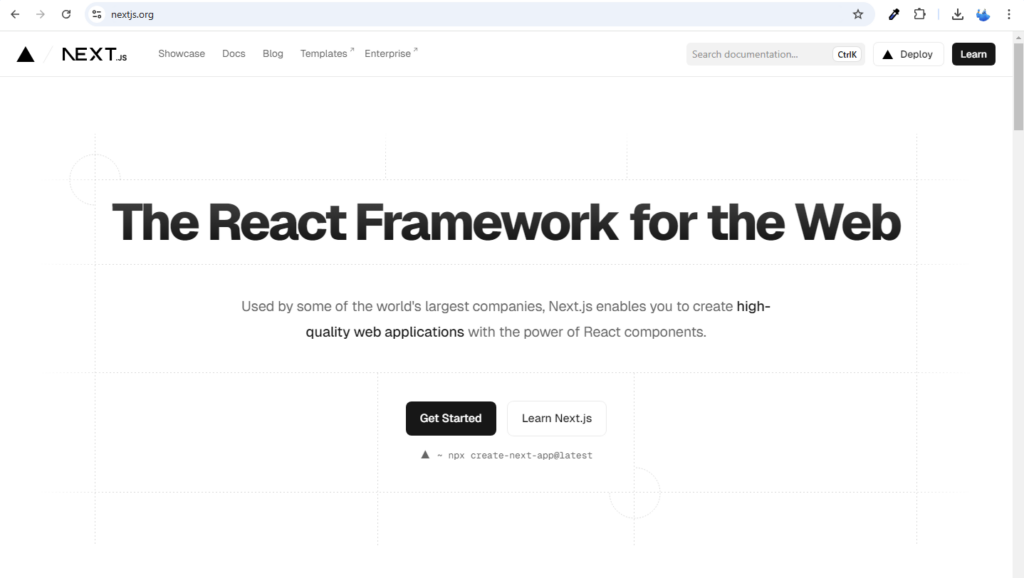
Next.js is a popular React framework that provides a set of tools to build fast, scalable, and optimized web applications. It offers features like these for website development:
Built-In CSS Support: You can easily use global CSS, component-level styles, and even CSS-in-JS solutions.
Server-Side Rendering (SSR): Automatically generates HTML on the server for each request, improving SEO and performance.
Static Site Generation (SSG): Pre-renders pages at build time for faster loading and better caching.
API Routes: Allows you to build API endpoints within the app itself, making it easy to integrate backend logic.
File-Based Routing: Automatically maps file structure to routes, so you don’t need to manually configure routing.
Incremental Static Regeneration (ISR): Allows you to update static pages after the site is built without rebuilding the whole app.
Image Optimization: Built-in image optimization with automatic resizing and lazy loading for better performance.
Fast Refresh: Quick, reliable updates to the UI while maintaining state, speeding up the development process.
Core Benefits:
- Automatic code splitting
- Built-in SEO optimization
- Versatile deployment options
The average salary for a Next.js developer in the Website Development industry varies by location and experience level.
Next.js Developer Salary
India:
- Average Salary: Approximately ₹2,44,862 per year.
- Salary Range: Salaries can vary significantly, with some developers earning between ₹17,00,000 and ₹58,60,000 annually.
United States:
- Average Salary: Approximately $145,654 per year.
- Salary Range: Between $70,000 and $232,000 annually.
- Hourly Rate: Around $60 per hour, which is about 30% higher than the national average hourly wage.
Frequently Asked Questions on Development Frameworks
Is WordPress a web framework?
Here’s the distinction:
Web Framework: A web framework (e.g., Laravel, Django, Angular) is a toolkit or library designed to help developers build web applications by providing pre-written code for common functionality (e.g., routing, database access, templating).
Content Management System (CMS): A CMS, like WordPress, is a software application that allows users to create, manage, and modify website content without requiring extensive technical knowledge. It focuses on simplifying the creation and website Development, often providing themes and plugins for easy customization.
Which framework is used for website development?
Is PHP a web framework?
Is React JS a framework?
Is React backend or frontend?
Which web framework is fastest?
For backend: Fiber (Go) and FastAPI (Python) are considered among the fastest.
For frontend: Svelte is known for its speed and small bundle size.
Which framework is most in demand?
For backend: Node.js (via frameworks like Express.js) and Django are popular choices.
Which is better, Django or React?
Django: A backend framework for building web applications with server-side logic.
React: A frontend library for building dynamic user interfaces.
A combination of both can be used for full-stack development.
How do I choose a web framework?
Project requirements (e.g., API-focused, e-commerce, etc.)
Programming language preference
Community support and documentation
Learning curve
Performance needs
Future scalability
Which is better, Laravel or Django?
Django (Python): Excellent for projects needing scalability, rapid development, and strong security.
Choice depends on your project needs and familiarity with PHP or Python.
Which web framework is easiest to learn?
Backend: Flask (Python) and Express.js (Node.js) are simple to start with.
Your prior programming knowledge can also influence this.
The Role of Frameworks in Digital Marketing
Frameworks like Next.js and Angular are instrumental for website Development that support robust Digital Marketing campaigns. Optimized loading times, mobile responsiveness, and dynamic content are critical for higher search engine rankings and better user engagement. For professional services, consider Labhanya Technologies’ Digital Marketing Services.
Choosing the Right Framework
Selecting the best framework depends on several factors:
- Project Requirements: Evaluate the complexity and scale of your project.
- Developer Expertise: Choose a framework that aligns with your team’s skills.
- Future Scalability: Opt for frameworks that can grow with your business needs.
For example, if your focus is on Website Design, Vue.js or React.js might be the best options. However, for backend-heavy Website Development, Django or Laravel could be more suitable.
The Importance of Professional Expertise
Working with experts ensures your website is built on the right framework. Companies like Labhanya Technologies specialize in leveraging the latest frameworks to deliver cutting-edge solutions for Website Development and Website Design.
Trends in Website Development Frameworks
As we move forward, some trends are reshaping the landscape of Website Development:
- AI-Driven Development: Integration of AI tools within frameworks to automate coding and testing.
- Micro-Frontends: Breaking down applications into smaller, manageable parts.
- Serverless Architecture: Building applications without managing server infrastructure.
Recommendations for Digital Marketing Services
A well-developed website is a cornerstone of effective Digital Marketing. Partner with Labhanya Technologies for Digital Marketing Services to amplify your online presence. Their expertise in leveraging modern frameworks ensures your website aligns with your marketing goals.
Conclusion
The ‘Best Frameworks for Website Development in 2026’ have already transformed the way we approach coding in web projects. Frameworks like React.js, Angular, Vue.js, Django, Laravel, and Next.js offer unparalleled advantages for Website Design, development, and Digital Marketing. By leveraging these tools and working with experts like Labhanya Technologies, businesses can stay ahead in the competitive digital landscape.